Showing posts with label Nova Scotia. Show all posts

Sunday, October 1, 2017

Autumn Leaves - Beauty


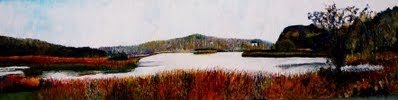
Apple River - Photo - Catherine Meyers


Autumn Leaves - Beauty

When Autumn comes around every year, it's always a little bitter sweet. I experience a multi-sensory, radiant beauty living in the Nova Scotia countryside, where land, sea and sky meet. I also experience a quiet sense of sadness, that comes to the surface. My soul and body will remember the losses of the year(s) that have passed, even if my mind doesn't. I've come to believe consciousness is found in the body.

                                                                   "Beauty is the radiance of truth."
                                                                                            - Saint Augustine

There are many people who share in these feelings with the arrival of Autumn. It's simply part of the Life/Death/Life cycle that we spend introspectively processing how it's all manifested and born out, creating meaning from our experiences.

                                         "God gave us memory so that we might have roses in December."
                                                                                                                        - Thomas Merton

My heart lives in the beauty of Spring, but I know beauty only visits it doesn't linger.

Monday, August 14, 2017

Connection, Disconnection, Kerfuffles


Kay's Violets


Human beings are such creatures of habit. Good or bad we all have habits and routines.

My habit and routine is to write everyday, long hand cursive writing and online via my blogs. But when my internet is down, I go into the jonesing mode pretty darned fast.  This is what happened to me over the past two and a half days. I was headed for a kerfuffle.

It's so true, you don't know what you've got til it's gone.

We live in such a privileged world, where so much is taken for granted in North America. We're so busy thinking about ourselves, in our preoccupied, so called connected lives. This is what immediately came to my mind today, after not being able to access the internet and being faced with the question, "what do I do now?" So I went to my go to solution, writing, painting, out in the garden,  go for a walk, visit a neighbour.

I have lots of time and solace to pay attention to my creativity and inner reflection. But regardless, the internet is my guilty pleasure and yes it's my addiction and sometimes my diversion, and I can easily get lots of nothing done, and not do the things I need to do. I know I'm not alone in this dependency and diversion.

The recent collective experience of disconnection that took place in Nova Scotia. with the cell phone service providers, due to a cut cable in the remote woods, was a good example of how the majority of us are so completely dependent on this technical connection, and I don't think it's healthy, safe or secure. And so we have to find ways and means to make contingency plans for ourselves.

Most of us were affected in one way or another and in a real big kerfuffle for four days. There was chaos and confusion in airports, financial institutions and disrupted online banking and purchases. I'm sure there were probably other unknown residual effects as well.

I don't have a cell phone nor do I want one.  I say this not to be smug, but just to stress the reality of how dependent we all are on people, places, and things and how we delude ourselves in believing they'll always be there, until suddenly their not, and we find ourselves in some precarious or vulnerable situation.

I'm always so grateful to have my radio so I can listen to what's going on in the world. Same old stuff but undoubtedly is getting worse. Sadly I'm afraid the reality is, we've forgotten, or don't know how to have real human relationships with one another. I ask myself, are we losing our humanity? I refuse to believe this and in spite of world circumstances I remain hopeful.

If we could just have some down time away from our busyness and access to all our gadgets maybe our thoughts would turn inward, take an inventory, and prioritize what's really important in our lives.

In the small rural coastal community where I live people know what relationships mean and they remember how important relationship and connection with others is and this is reflected in many real and tangible ways such as community celebrations, gatherings and get-togethers, where people interact face to face, young and old alike. We feel a strong sense of belonging to one another.


Taking a walk up my country road to have an afternoon visit with my elder friends, to deliver a loaf of homemade bread, I listen to stories over a cup of tea and good conversation, always gives me a deep sense of contentment and belonging and I go home happier than I was before I came.

I don't have a really busy life in the sense of feeling overwhelmed with busyness and not having any time to myself. I've had enough of that in the past.
These days I focus on having a quality of life, that involves creativity, nature, critters and lots of Hygge, something the world needs much more, especially now, in these troubled times.
  
Hygge (“heu-gah”). The art of building sanctuary and community, of inviting closeness and paying attention to what makes us feel open hearted and alive. To create well-being, connection and warmth. A feeling of belonging to the moment and to each other. Celebrating the everyday.

Hygge happens when we commit to the pleasure of the present moment in its simplicity. It’s there in the small rituals and gestures we undertake to give everyday life value and meaning, that comfort us, make us feel at home, rooted and generous.

We all hygge – around a table for a shared meal, beside a fire on a wet night, making coffee together at work, in the bath with a single candle, wrapped in blankets at the end of a day on the beach, sheltering from the rain at a bus stop, lying spoons, baking in a warm kitchen, alone in bed with a hot water bottle and a good book.

In our overstretched, complex, modern lives, hygge is a resourceful, tangible way to find deeper connection to our families, our communities, our children, our homes and our earth. It’s an uncomplicated, practical method of weaving the stuff of spirit and heart into daily life without sentimentality then taking time to celebrate it on a human scale.

Hygge is a kind of enchantment – a way of stirring the senses, the heart and the imagination, of acknowledging the sacred in the secular – a way of giving something ordinary a special context, spirit and warmth, taking time to make it extraordinary.

Hygge is about appreciation. It’s about how we give and receive. Hygge is about being not having. ”

Sunday, April 16, 2017

Where's My Easter Bonnet?


 Spring, the Easter Season and all that goes along with it, is my very favourite time of the year. I'm so grateful to be alive to celebrate rebirth and new growth. All nature is coming into it's own once again, lifts my spirit and fills me with thoughts of happiness and hope.

There are many things to pray for right now living in our troubled world, especially prayers for world peace.
I find myself praying for this more than anything else.

The one particular thing I wish for on a personal level, which to some will appear trivial and even silly but I always think about how I wish I could find an Easter Bonnet. I know this might seem like is a nostalgic left over from a my childhood and adolescence. But for me it was an important glue that edified and involved family, friends and a face to face, in the flesh social connection with our community,  a time when Easter was celebrated for spiritual reasons and it wasn't co-oped by commercialism with giant gross wax chocolate bunnies and copious amount of sugary candy brought by the big fictitious secular Easter Bunny.
 Capitalism, work and money has become what we mostly edify and value these days.

There are a group of individuals I think who haven't forgotten the meaning of Easter and celebrate accordingly. I wrote about a group of women in Nova Scotia that have continued the Easter traditions and I think you might call it having an "hattitude" of gratitude.

Happy Easter friends, pray for peace and may you find your own Easter Bonnet!


Saturday, February 25, 2017

Bagpipes Transform Lives


My friend Eugene at the Nova Scotia Boarder


I don't remember the first time I heard bagpipes but I suspect it might have been when I my family made the very first trek driving from Ontario back to Nova Scotia, when I was just a kid. Once we hit the New Brunswick/Nova Scotia Boarder crossing there was always a Piper in the middle of a big flower garden playing his heart out.

I grew up with a friend who was actually was one of those Pipers at the Nova Scotia boarder. Eugene made a fine figure in his kilt and did a grand job playing his pipes.

It wasn't until I got older that the bagpipes really resonated with me. My heart would get very nostalgic and I'd get the feeling I was being called back to another place and an ancient time.  I'm not sure if that place was the heather covered hills and dales of Scotland, but it was definitely ancient.

The history of bagpipes is ancient and after listening to a program about the pipes they held an even deeper fascination for me.

About a week later after hearing this program I learned about Jermaine Downey  who talked about his love and passion for piping and how the bagpipes saved his life. He has a special vision and mission to help kids by teaching them to play the bagpipes and believes in the power of music to transform lives.

Jermaine Downey in Scotland


Tuesday, September 13, 2016

Creative Restoration


Tidnish Shore - Nova Scotia - Photo, Catherine Meyers 2016


This past weekend I spent time with a dear life long friend, my soul sister, at her cottage by the Nova Scotia ocean. We communed with nature and with one another the whole weekend. It was one of the very best things we could do for our creative feminine souls. However conscious or perhaps even unconsciously, all of our senses were engaged, leaving us feeling mentally restored, in the same way food and water restores the body.

The weather was spectacular and on Saturday we traveled to a very rural part of Nova Scotia to tour a beautiful vineyard. I think it was beyond our expectations and we thoroughly enjoyed ourselves in every way. Beautiful vistas, grand food and drink, music, good company, and who could ask for more?

Most of us find ourselves increasingly connected and attached to the screens of our tech devices and are disconnected and almost detached completely from our bodies, without engaging most of our senses. We are living in our heads and dragging our bodies around much of the time. This is no way to live healthfully.

Being in a beautiful, natural environment where all of our senses are engaged, directly affects what's happening in our brain and in turn, this affects all aspects of how and what we learn, increasing our cognitive function. For me this is a big part of the spirituality of creativity. It's how I get in touch with who I am as a creative woman and my connection with the earth.

Communing with nature enables us to become more insightful, our problem solving abilities and creative reasoning is improved. Energy increases, depression decreases, our analytical ability and ideas are replenished. Our ability to focus improves through a reflective introspection, that happens naturally when we are outside surrounded by nature's beauty.

It stands to reason that the further away human beings are from nature that their health worsens.

I have developed a habit of sitting outside first thing in the early morning to write, read and enjoy my morning coffee. It's a great way to give my brain a boost first thing, and to get focused for the rest of my day.

Malagash - Jost Vineyard - Photo, Catherine Meyers 2016

Wednesday, April 6, 2016

Painting Another Lighthouse


Painting a lighthouse that was life size would be a monumental project and I would never entertain that idea. The lighthouse I finished painting today I was commissioned to paint. It's a metallic lighthouse replica, approximately five feet high. I was very happy to get the commission, none the less the work was tedious and slow going. There is always something to be learned by doing work that you would not normally choose to do, mostly you learn about yourself I think, especially when the work is challenging.


This project is nothing like the usual kind of painting surface, nor the usual kind of paint I am use to working with. It was challenging enough to complete, but it wasn't something I could rush even a bit, so it was long and drawn out. I am very happy it's done and that I'm satisfied with the outcome.


It appears the past few years my life has been surrounded by lighthouses as a subject matter in the paintings I have been commissioned to paint, which is a good thing because it's given me a new and greater appreciation of them.


I forgot to mention the utilitarian purpose of the lighthouse is to be used as a recycling bin outside a coffee shop.

The video I've posted is of a magnificent spot close to where I live, called Cape D'or. I spent some time working there a number of years ago. It 's what I consider to be quintessential Nova Scotia.


Sunday, March 29, 2015

Marvin (Popcorn) Sutton - Moonshine Mountain Man

Marvin (Popcorn) Sutton - M. Reach


The other day I heard that the Appalachian mountains on the East Coast of North America were once joined all together with Scotland, before the ocean separated the continents. This truly is the history of Appalachia  with ancestors from the British Isles.

I've always been very drawn to Appalachia, the music, the people, and their connection with the land. Living along part of Appalachia trail, here in Nova Scotia it feels close to my heart and soul. It's a big part of my own family history.

The story of Appalachia is rich, tragic and beautiful. Alan Lomax did a documentary called Appalachian Journey , an amazing historical video made in 1991, that I just finished viewing. It's about an hour of watching but if you want to see something that certainly gives an in depth history of Appalachia, it is well worth watching.

There are many contemporary correlations in the way the land today in North America is being stripped for fossil fuel with fracking and oil, and the way North Carolina was stripped for coal and gold, leaving the land decimated and it's people in poverty.

I was especially captured by the linguistics of the people, the music and how folk in the mountains where basically forced into moon-shining to survive because of the dire poverty and the way corn was harvested.

A few years back I happened upon a You-tube video that musician Seasick Steve did about a mountain man by the name of Marvin (Popcorn) Sutton. It was really something. Here's short film done by photographer and film maker Andy Armstrong.


Thursday, November 20, 2014

Amazing Family Secrets - Claude


"Claude" - Archaeologist/ Artist Talva Jacobson

I have relatives that were born in France and Belgium, Poland and Germany. I have difficulty finding out about many of my relatives due to the war. This feels to me, like a big part of my identity is missing, because I can't go back very far in my family of origin, but I know more about my family than many others. I just recently was able to see pictures of my paternal great grand parents. It was an emotional experience.

 I can not imagine what Acadian families, and their community must be feeling, and experiencing after seeing what archaeologists Jonathan Fowler and Tanya Peckmann at Saint Mary’s University in Halifax had discovered, the skull of an Acadian child, dating back to 1740.

Talva Jacobson, an archaeologist and artist from Alberta, studied facial reconstruction and produced the reconstructed face of this child, they are calling Claude.

What an amazing creative gift for an artist to have, and to be able to give, to those searching for missing relatives or trying to find their family origins.

Sunday, September 7, 2014

The Hole In The Soul


Some time ago I thought to myself, I have spent my life single and alone. Growing up with a brother ten years older, I was by myself, mostly, other than when I was with adults, or my friends. I was profoundly aware of my aloneness, I was used to it, even though I didn't appreciate or understand what it all meant.

I believe I am fortunate to be a creative individual, because I found solace, and a diversion in creating art, entertaining myself, making others laugh, or playing music. I am a social  individual who enjoys the interaction with others, but in moderation. I can be one of those who at times, prefers the company of animals over humans. Animals have always been my companions who will love and accept you unconditionally. I'm lost without my critters.

As a young teenager I craved the business of city life, being brought up in Toronto and in other cities. I attended art school in the city. There were many people, places, and things that I loved about it, but simultaneously I was loosing myself, and my way in life, being consumed with substance abuse and continuous unhealthy relationships. This all resulted in what I call, the hole in my soul, which I could never fill, but was desperately trying to do find something to complete me. I was never comfortable in my own skin, and was unhappy with my life with really no sense of where I belonged or who I was.

After coming to understand, in a painful way, that I was very unhappy, I reflected on asking myself, what I really wanted in life, and what I needed to be happy, and how I could go about finding the answers to my questions. The one paramount question I asked, made all the difference for me, when I finally got the answer. When was the happiest time in my life? The answer to my question came immediately, and quite easily, and I think the question had been waiting to be asked. The answer was when I had the experiences of being with nature, in the countryside, during my childhood, particularly when my family would take that seemingly never ending road, trip eating copious numbers of my mother's sandwiches, while my father drove like he was on a mission, right through, from Ontario to Nova Scotia.

It was a wonderful feeling to finally arrive at my grandmother's house. Everything had and was in it's own place, and this was mine, Nova Scotia. I would play for hours by myself with her nick-knacks on the living room floor, creating  menageries and the world of my own imaginings. Spending glorious Summer days playing the piano,  painting pictures, or going for long walks with my mother, or swimming in the ocean.

 Being in the garden with my grandfather, or on the swing that he'd made in his old shed especially for me, all these are memories of comforting solitude, and happiness for having had a strong sense of belonging, because I was surrounded with nature and I felt love.

Today I enjoy my solitude every day, living in the countryside, close to the woods, to the water, and surrounded by nature. This is so good for my soul and I feel a deep sense of happiness because this is where I belong and I know I am loved. 

People ask me, do you like living it there? I answer, I must, I've lived here for twenty years, alone, comfortable in my own skin, clean and sober for twenty years and I no longer suffer from the hole in the soul.

Today I have posted the following article about solitude and creativity, from one of my very favourite sites, Brain Pickings.

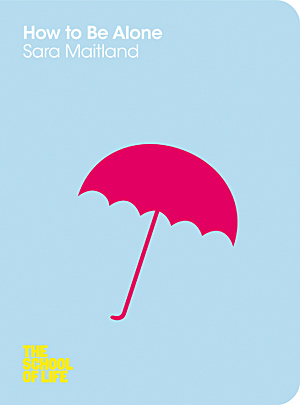
 How to Be Alone: An Antidote to One of the Central Anxieties and Greatest Paradoxes of Our Time

by
“We live in a society which sees high self-esteem as a proof of well-being, but we do not want to be intimate with this admirable and desirable person.”
If the odds of finding one’s soul mate are so dreadfully dismal and the secret of lasting love is largely a matter of concession, is it any wonder that a growing number of people choose to go solo? The choice of solitude, of active aloneness, has relevance not only to romance but to all human bonds — even Emerson, perhaps the most eloquent champion of friendship in the English language, lived a significant portion of his life in active solitude, the very state that enabled him to produce his enduring essays and journals. And yet that choice is one our culture treats with equal parts apprehension and contempt, particularly in our age of fetishistic connectivity. Hemingway’s famous assertion that solitude is essential for creative work is perhaps so oft-cited precisely because it is so radical and unnerving in its proposition.
A friend recently relayed an illustrative anecdote: One evening during a short retreat in Mexico by herself, she entered the local restaurant and asked to be seated. Upon realizing she was to dine alone, the waitstaff escorted her to the back with a blend of puzzlement and pity, so as not to dilute the resort’s carefully engineered illusory landscape of coupled bliss. (It’s worth noting that this unsettling incident, which is as much about the stigma of being single as about the profound failure to honor the art of being alone, is one women are still far more likely to confront than men; some live to tell about it.)
Solitude, the kind we elect ourselves, is met with judgement and enslaved by stigma. It is also a capacity absolutely essential for a full life.
That paradox is what British author Sara Maitland explores in How to Be Alone (public library) — the latest installment in The School of Life’s thoughtful crusade to reclaim the traditional self-help genre in a series of intelligent, non-self-helpy yet immeasurably helpful guides to such aspects of modern living as finding fulfilling work, cultivating a healthier relationship with sex, worrying less about money, and staying sane.
While Maitland lives in a region of Scotland with one of the lowest population densities in Europe, where the nearest supermarket is more than twenty miles away and there is no cell service (pause on that for a moment), she wasn’t always a loner — she grew up in a big, close-knit family as one of six children. It was only when she became transfixed by the notion of silence, the subject of her previous book, that she arrived, obliquely, at solitude. She writes:
I got fascinated by silence; by what happens to the human spirit, to identity and personality when the talking stops, when you press the off button, when you venture out into that enormous emptiness. I was interested in silence as a lost cultural phenomenon, as a thing of beauty and as a space that had been explored and used over and over again by different individuals, for different reasons and with wildly differing results. I began to use my own life as a sort of laboratory to test some ideas and to find out what it felt like. Almost to my surprise, I found I loved silence. It suited me. I got greedy for more. In my hunt for more silence, I found this valley and built a house here, on the ruins of an old shepherd’s cottage.
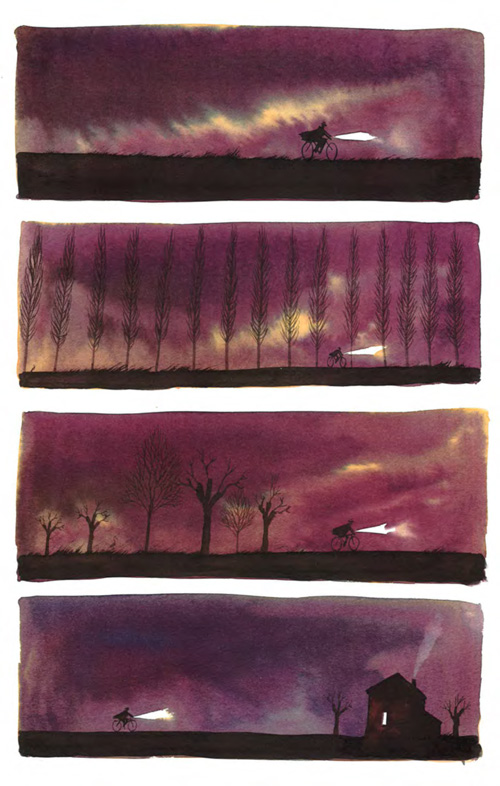
Illustration by Alessandro Sanna from 'The River.' Click image for more.
Maitland’s interest in solitude, however, is somewhat different from that in silence — while private in its origin, it springs from a public-facing concern about the need to address “a serious social and psychological problem around solitude,” a desire to “allay people’s fears and then help them actively enjoy time spent in solitude.” And so she does, posing the central, “slippery” question of this predicament:
Being alone in our present society raises an important question about identity and well-being.

How have we arrived, in the relatively prosperous developed world, at least, at a cultural moment which values autonomy, personal freedom, fulfillment and human rights, and above all individualism, more highly than they have ever been valued before in human history, but at the same time these autonomous, free, self-fulfilling individuals are terrified of being alone with themselves?

We live in a society which sees high self-esteem as a proof of well-being, but we do not want to be intimate with this admirable and desirable person.
We see moral and social conventions as inhibitions on our personal freedoms, and yet we are frightened of anyone who goes away from the crowd and develops “eccentric” habits.
We believe that everyone has a singular personal “voice” and is, moreover, unquestionably creative, but we treat with dark suspicion (at best) anyone who uses one of the most clearly established methods of developing that creativity — solitude.
We think we are unique, special and deserving of happiness, but we are terrified of being alone.

We are supposed now to seek our own fulfillment, to act on our feelings, to achieve authenticity and personal happiness — but mysteriously not do it on our own.
Today, more than ever, the charge carries both moral judgement and weak logic.
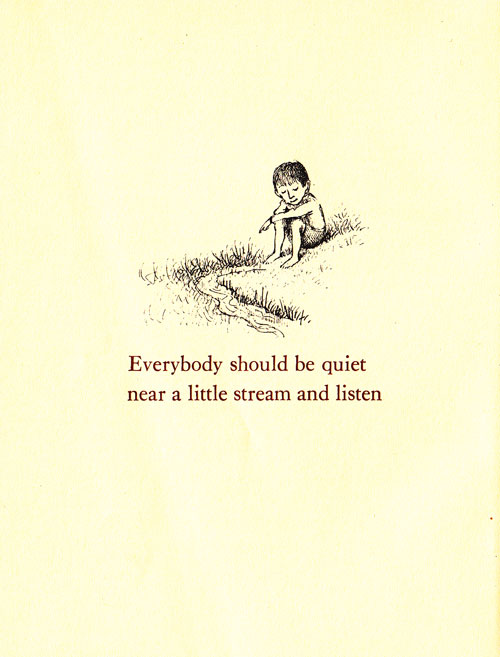
Illustration by Maurice Sendak from 'Open House for Butterflies' by Ruth Krauss. Click image for more.
Curiously, and importantly, mastering the art of solitude doesn’t make us more antisocial but, to the contrary, better able to connect. By being intimate with our own inner life — that frightening and often foreign landscape that philosopher Martha Nussbaum so eloquently urged us to explore despite our fear — frees us to reach greater, more dimensional intimacy with others. Maitland writes:
Nothing is more destructive of warm relations than the person who endlessly “doesn’t mind.” They do not seem to be a full individual if they have nothing of their own to “bring to the table,” so to speak. This suggests that even those who know that they are best and most fully themselves in relationships (of whatever kind) need a capacity to be alone, and probably at least some occasions to use that ability. If you know who you are and know that you are relating to others because you want to, rather than because you are trapped (unfree), in desperate need and greed, because you fear you will not exist without someone to affirm that fact, then you are free. Some solitude can in fact create better relationships, because they will be freer ones.
And yet the value of aloneness has descended into a downward spiral of social judgment over the course of humanity. Citing the rise of “male spinsters” in the U.S. census — men over forty who never married, up from 6% in 1980 to 16% today — Maitland traces the odd cultural distortion of the concept itself:
In the Middle Ages the word “spinster” was a compliment. A spinster was someone, usually a woman, who could spin well: a woman who could spin well was financially self-sufficient — it was one of the very few ways that mediaeval women could achieve economic independence. The word was generously applied to all women at the point of marriage as a way of saying they came into the relationship freely, from personal choice, not financial desperation. Now it is an insult, because we fear “for” such women — and now men as well — who are probably “sociopaths.”
This fairly modern attitude, which casts voluntary aloneness as a toxic trifecta of “sad, mad, and bad” — is reinforced via rather dogmatic circular logic that doesn’t afford those who choose solitude the basic dignity of their own choice. Reflecting on the prevalent response of pity — triggered by the “sad” portion of the dogma — Maitland plays out the exasperating impossibility of refuting such social assumptions:
If you say, “Well, no actually; I am very happy,” the denial is held to prove the case. Recently someone trying to condole with me in my misery said, when I assured them I was in fact happy, “You may think you are.” But happiness is a feeling. I do not think it — I feel it. I may, of course, be living in a fool’s paradise and the whole edifice of joy and contentment is going to crash around my ears sometime soon, but at the moment I am either lying or reporting the truth. My happiness cannot, by the very nature of happiness, be something I think I feel but don’t really feel. There is no possible response that does not descend almost immediately to the school-playground level of “Did, didn’t; did, didn’t.”
Underlying these attitudes, Maitland argues, is the central driver of fear — fear of those radically different from us, who make choices we don’t necessarily understand. This drives us, in turn, to project our fright onto others, often in the form of anger — a manifestation, at once sad, mad, and bad, of Anaïs Nin’s memorable observation that “it is a sign of great inner insecurity to be hostile to the unfamiliar.”
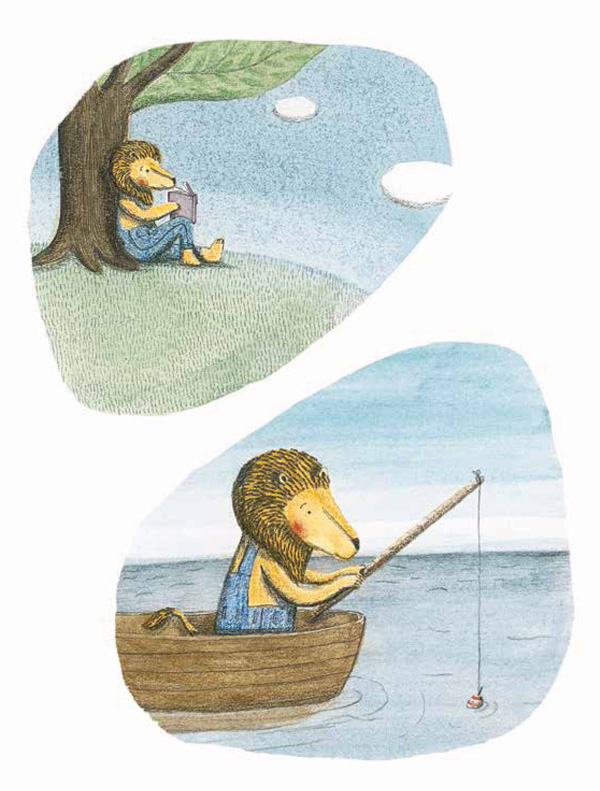
Illustration by Marianne Dubuc from 'The Lion and the Bird.' Click image for more.
These persistently reinforced social fears, she notes, have chilling consequences:
If you tell people enough times that they are unhappy, incomplete, possibly insane and definitely selfish there is bound to come a grey morning when they wake up with the beginning of a nasty cold and wonder if they are lonely rather than simply “alone.”
(This crucial difference between aloneness and loneliness, in fact, is not only central to our psychological unease but also enacted even in our bodies — while solitude may be essential for creativity and key to the mythology of genius, loneliness, scientists have found, has deadly physical consequences on our risk for everything from heart disease to dementia.)
Paradoxically, Maitland points out, many of our most celebrated cultural icons had solitude embedded in their lifestyle and spirit, from great explorers and adventurers to famous “geniuses.” She cites the great silent film actor Greta Garbo, a famous loner, as a particularly poignant example:
Garbo introduced a subtlety of expression to the art of silent acting and that its effect on audiences cannot be exaggerated… In retirement she adopted a lifestyle of both simplicity and leisure, sometimes just ‘drifting’. But she always had close friends with whom she socialized and travelled. She did not marry but did have serious love affairs with both men and women. She collected art. She walked, alone and with companions, especially in New York. She was a skillful paparazzi-avoider. Since she chose to retire, and for the rest of her life consistently declined opportunities to make further films, it is reasonable to suppose that she was content with that choice.
It is in fact evident that a great many people, for many different reasons, throughout history and across cultures, have sought out solitude to the extent that Garbo did, and after experiencing that lifestyle for a while continue to uphold their choices, even when they have perfectly good opportunities to live more social lives.
So how did our present attitudes toward solitude emerge? Maitland argues that our lamentable refusal to afford those who choose aloneness “the normal tolerance of difference on which we pride ourselves elsewhere” is the result of a “very deep cultural confusion”:
For two millennia, at least, we have been trying to live with two radically contrasting and opposed models of what the good life would or should be. Culturally, there is a slightly slick tendency to blame all our woes, and especially our social difficulties, either on a crude social Darwinism or on an ill-defined package called the “Judaeo-Christian paradigm” or “tradition.” Apparently this is why, among other things, we have so much difficulty with sex (both other people’s and our own); why women remain unequal; why we are committed to world domination and ecological destruction; and why we are not as perfectly happy as we deserve. I, for one, do not believe this — but I do believe that we suffer from trying to hold together the values of Judaeo-Christianity (inasmuch as we understand them) and the values of classical civilization, and they really do not fit.
She traces the evolution of that confusion all the way back to the Roman Empire, with its ideals of public and social life. Even the word “civilization” bespeaks these values — it comes from civis, Latin for “citizen.” (Though it warrants noting that one of the greatest and most enduring Roman exports issued the memorable admonition that “all those who call you to themselves draw you away from yourself.”) Still, the Romans were notorious for their lust for power, honor, and glory — ideals invariably social in nature and crucial to the political cohesion of society when confronted with the barbarians at the gate. Maitland writes:
In these circumstances solitude is threatening — without a common and embedded religious faith to give shared meaning to the choice, being alone is a challenge to the security of those clinging desperately to a sinking raft. People who pull out and “go solo” are exposing the danger while apparently escaping the engagement.
Maitland fast-forwards to our present predicament, the product of millennia of cultural baggage:
No wonder we are frightened of those who desire and aspire to be alone, if only a little more than has been acceptable in recent social forms. No wonder we want to establish solitude as “sad, mad and bad” — consciously or unconsciously, those of us who want to do something so markedly countercultural are exposing, and even widening, the rift lines.
But the truth is, the present paradigm is not really working. Despite the intense care and attention lavished on the individual ego; despite over a century of trying to “raise self-esteem” in the peculiar belief that it will simultaneously enhance individuality and create good citizens; despite valiant attempts to consolidate relationships and lower inhibitions; despite intimidating efforts to dragoon the more independent-minded and creative to become “team players”; despite the promises of personal freedom made to us by neoliberalism and the cult of individualism and rights — despite all this, the well seems to be running dry. We are living in a society marked by unhappy children, alienated youth, politically disengaged adults, stultifying consumerism, escalating inequality, deeply scary wobbles in the whole economic system, soaring rates of mental ill-health and a planet so damaged that we may well end up destroying the whole enterprise.
Of course we also live in a world of great beauty, sacrificial and passionate love, tenderness, prosperity, courage and joy. But quite a lot of all that seems to happen regardless of the paradigm and the high thoughts of philosophy. It has always happened. It is precisely because it has always happened that we go on wrestling with these issues in the hope that it can happen more often and for more people.
And wrestle we do, often trying to grasp and cling our way out of solitude — a state we don’t fully understand and can’t fully inhabit to reap its rewards. Our two most common tactics for shielding against solitude, Maitland notes, are the offensive fear-and-projection strategy, where we criticize those capable of finding joy in solitude and condemn them to the sad-mad-bad paradigm, and the defensive approach, where we attempt to insulate ourselves from the risk of aloneness by obsessively accumulating a vast network of social ties as a kind of “insurance policy.” In one of her most quietly poignant asides, Maitland whispers:
There is no number of friends on Facebook, contacts, connections or financial provision that can guarantee to protect us.
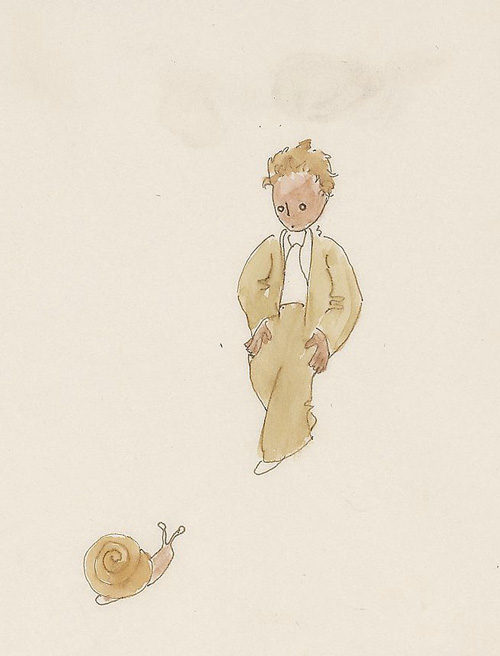
One of Antoine de Saint-Exupéry’s original watercolors for The Little Prince. Click image for more.
Our cultural ambivalence is also manifested in our chronic bias for extraversion despite growing evidence for the power of introverts. Maitland writes:
At the same time as pursuing this “extrovert ideal,” society gives out an opposite — though more subterranean — message. Most people would still rather be described as sensitive, spiritual, reflective, having rich inner lives and being good listeners than the more extroverted opposites. I think we still admire the life of the intellectual over that of the salesman; of the composer over the performer (which is why pop stars constantly stress that they write their own songs); of the craftsman over the politician; of the solo adventurer over the package tourist… But the kind of unexamined but mixed messages that society offers us in relation to being alone add to the confusion; and confusion strengthens fear.
Among Maitland’s toolkit of “ideas for overturning negative views of solitude and developing a positive sense of aloneness and a true capacity to enjoy it” are the exploration of reverie and the practice of facing the fear. She enumerates the five basic categories of rewards to be reaped from unlearning our culturally conditioned fear of aloneness and learning how to “do” solitude well:
  1. A deeper consciousness of oneself
  2. A deeper attunement to nature
  3. A deeper relationship with the transcendent (the numinous, the divine, the spiritual)
  4. Increased creativity
  5. An increased sense of freedom
In the remainder of How to Be Alone, Maitland goes on to offer a series of “exercises” along each of these five directions of aspiration — psychological strategies for retuning our relationship with solitude.
Tuesday, July 8, 2014

" Aging By The Book "


This past weekend we experienced  in the Maritimes, a tropical storm, the remnants of Hurricane Arthur, a name that sure sounds innocuous enough, but it packed quite a wallop, and there are still many throughout Nova Scotia and New Brunswick without power, due to downed power lines as a result of numerous fallen trees.

The storm arrived July 4th weekend and at the same time a group of life long friends, and myself, got together for our annual WW ( Women's Weekend ). Fortunately where we had our weekend we did not loose power. We ate, laughed, danced, and had a great time engaging in some heart to heart conversations, on a range of subjects about art, creativity, kids and grand kids etc and generally got caught up on where we are in our lives. I would describe it as relating to each other, our present life stories. There was an overall focus on life long learning, and we shared with one another what  books we have been reading.


Getting together with old friends is a very satisfying thing to do, because we know one another's story, and it is a good thing to stay in touch, because we can catch up, reestablish our connections, and bonds of friendship, and even meet new friends, these all help to reinforce who we are, and it all gives us a sense of belonging. Our shared life stories I think, help us to understand who we are, and the aging process.

One of my friends gave everyone of the women a gift of copied original art works in the form of magnets in envelopes with a quotes. The quote on my envelope was from the poet Emily Dickinson.

" We never know how high we are 
     Till we are called to rise;
   And then, if we are true to plan,
   Our statures touch the skies. "

Yesterday I heard a rebroadcast of the Ideas program, Aging By The Book  which I thought was a very poignant, inspiring, and relevant to me and my life long friends, that I have know for so many years.


Sunday, February 9, 2014

Why Story Telling Is Important. Once Upon A Time I Ate Your Hamster This Morning...


I believe these two birds, in Nova Scotia, the Snowy Owl and Raven are telling their story to one another. All animals including ourselves have a story to tell, whether we know it or not. If we tell it, and there is someone to listen, we can hear, and hopefully understand it with our heart, if we listen, and we speak with our heart.

 This past Friday Night, I had  this wonderfully rewarding kind for experience, an evening of story telling with peers, old, and new found friends, and artists, at a venue called Baked Ham, in Sackville, New Brunswick; and no, no ham was baked or eaten.


I heard  fabulous stories about helium balloons following an invisible professor around her house, a beautiful cellist, and songstress who described herself as a Newf-Scotian, or was that a Scotian-Newf? I heard a heart warming story about how bags of stolen apples lead to a young man becoming an award winning, world famous, choir member. A story was told about an adventurous vacation that had us sitting on the edge of our seats, when the story relayed a unexpected situation that developed, taking a sudden twist that presented itself, as being a potentially, and possibly very dangerous scenario. involving a arms dealer, and men in black.
The story of WWF and a young man's experience with famous wrestlers and how this affected his life.
I told my story about a cross country trip by train, bus, and then crossing an ice bridge, on the last day before it closed, to Yellowknife NT in 1981.


" Stories set the inner life in motion, and this is particularly important where the inner life is frightened, wedged, or cornered. Story greases the hoists and pulleys, it causes adrenaline to surge, shows us the way out, down, or up, and for our trouble, cuts for us fine wide doors in previously blank walls, openings that lead to the dreamland, that lead to love and learning, that lead us back to our own real lives as knowing wildish women." (p. 20)

                                                 -  Women Who Run With The Wolves - Dr. Clarissa Pinkola Estes


I believe humans inherently know that stories are vital to understanding what it means to be human, and have been since the beginning of time. If you have ever experienced  the art of story telling, you will know how transforming it can be, to both the teller, and the listener. We have made an deep connection to another, which is essential to life, culture and society. Stories are the emotional glue that connects us to each other.

Bianca Filoteo makes this list comprehensive reasons why story telling is so important that I like very much.

So we can help others understand — our pain, our joy, our beliefs, our purpose, our desires, ourselves.
So we can warn others of what’s to come.
So we can share with others what we have already done.
So we can tell others what to expect — a few steps ahead, or further into the future.
So we can give each other hope — for those times we’re challenged with personal obstacles, or when we need to defeat our own demons.
So we can guide those who are lost — and help them find their way.
So we can learn life’s lessons.
So we can discover what love really is.
So we can celebrate.
So we can enjoy life with laughter.
So we can feel more compassion and less judgement.
So we can inspire others into action.
So we can know that we’re never alone.

Stories act as guideposts, and when we hear a story or we tell our own, though the stories may not be the same, we can identify with the emotions, and perhaps the experience of our  own story can help another to find their way along life's path. We are all emotional human animals that need stories.

Saturday, November 23, 2013

Not Quite Busy As a Beaver

I have been slowly and labouriously working at my wood pile and doing a detailed embroidered project for a friend the past month or so, and haven't been painting. This is about to change shortly, as I have a new series to work on, over the Winter months.

I have continued to work on my baskets over the Summer, and have been trying to get some inventory built up for the Christmas Down Shore Market. I've posted a few new creations.


Some one else has been busy with woodin' too, my resident beaver!


Monday, October 21, 2013

Transformation

 I've been slow in getting to my blog posts lately, as I've had some computer technical difficulties, been very busy and haven't found much to blog about as of late. It does make me feel good to know I've accomplished my four hundredth post, as of today.

Summer is long over. I have to accept that. Every year it's always the same ; can't believe it's gone, can't believe it's coming; Winter that is.

I recently wrote my thoughts about my simultaneous feelings of joy and sadness surrounding this season of Fall.

Autumn is bitter sweet
First such beauty
Then so bleak


 I think most people experience this. It has been a particularly stunning Autumn with the trees a cacophony in a glorious pallet of colours. Suddenly it's over, and bleakness ensues! Blaaa gak!

Since September I've been involved with numerous activities, have a list of yard chores to do, trying to get ready for the coming Winter, and especially with the seemingly unending "woodin" to do. And so I haven't had much time or inclination to get art done. I have been in the planning stage of a series of new work. I will be starting preliminary drawings shortly. Shortly, being the operative word, I need keep, at the forefront of my mind. In the Fall, I have the nagging feeling I'm always falling short, and can't get enough done.

The coming change in season is the time for me to draw close to that still quiet voice, and take an inventory, when the earth appears to be asleep and even dying. In actual fact it is transforming, and I hope I am involved always in that same kind of transformative process.

Living in the North West Territories for three years, I know, and understand what cabin fever is. This state requires a concerted conscious effort to get out, and participate in healthy social activity. I need to reach out to others, and get outside of my comfort zone. I've found myself doing this over the past few months, and it's helped me to feel less disconnected and in that funk with myself.

 My recent involvement in playing and singing again, at our local Open Mic nights, has given me a renewed sense of self, fulfillment and fun, in being part of a community and fellowship, brought together through music, and it certainly can be a great healing activity for many.

Yesterday an artist friend and I attended an art event in Parrsboro, Nova Scotia. The event was " Art in The Hall", which is sponsored by The Parrsboro Band Association. This was the second art event I participated in this year. Over the Summer I attended "Art In The Park".


 This community and cultural event brought together several artists within the area of Cumberland County. Some folks I had met in the past, and others I sure enjoyed meeting for the first time. It was a wonderful opportunity to feel a part of a rich creative, diverse and talented group of fellow artists, in a supportive, encouraging environment, along with meeting the public who came and it was great fun!


                        Wishing you all great transformation along life's journey!
 

Tuesday, July 2, 2013

Oh Canada Day Eh? History, Culture and Land


Last night as per my usual routine, Sunday evening I listen to some of my favourite shows on CBC Radio, My Play List, Tim Tamashiro's jazz program, and This American Life with Ira Glass, while I made baskets.  Then again, I am always listening to CBC Radio. I ended up posting on Facebook last night what I was listening to, and admitted that I have a co-dependent relationship with CBC Radio, and half jokingly said it's what makes me Canadian. This statement is really more true than I think.
My friend's mother shared with me that she's been listening to CBC since 1936, and mentioned some very interesting history about what she'd listened to over the many years of her life.  I thanked her for her comments, and thought to myself how much I have learned from CBC Radio over the span of my sixty years, and how Canadians grew up with radio. I believe this fact does reflect our Canadian culture, with CBC Radio being such a wonderful, educational, and informative resource. Where else or how else can we find out what is happening across this vast, mostly rural country, in such a intimate way that makes you feel like you are close to your fellow Canadians.
I have lived in just about every province in Canada and loved each province and Territory, but Nova Scotia is home for me.

I been thinking about what to blog about since my last post, had a few ideas, but couldn't seem to find and focus on one that I felt passionate about, until this day, Canada Day. I heard two programs this afternoon that seemed to encapsulate how I am feeling. Two words that most come to mind are nostalgic, concern, and pride for my country and culture. I got invited to come out and celebrate but I'm content to be blogging this post, pan fried flounder for supper, and then doing some painting for a special project I was asked to do, all while listening to the radio.

I am very proud and happy to be Canadian. No question. I am not so proud of our history related to so many Canadians that have been and continue to be marginalized, discriminated against, and yes even hated in the past, up to present day. It may be not overt as it once was, however the repercussions and consequences of this still are being played out in activism and movements like Idle No More, ongoing land claims, and Treaty rights etc.

Living in the North West Territories for several years, and having a late husband who was of Metis ancestry, I have always taken a special interest in First Nations people and concerns. I relate to the spiritual traditions and philosophy, following The Red Road.

The story of Louis Riel in his own words, is a vital and very significant part of Canadian history, that every Canadian should know about, what happened to him and why. It paints and colours the very fabric and identity of our country, and what it means to be living in Canada, within the context of this history, culture and land.


As a Maritimer from Nova Scotia, I feel strong ties with the land, and the sea. Both are a big part of my heritage. My ancestors were farmers, sea folk and coal miners. Music and creative endeavors are on both sides of my family. I have lived in just about every province, and Territory in Canada . I've loved each place, but my roots are in Nova Scotia, which will always be is home to me.

The break down of the family farm, the commitment to good stewardship of the land and sea, are all issues I think about a lot, with great trepidation for our future, and for our children's future, considering the state of our world, on a local and global scale.

The Change In Farming is an an award winning, PRIX ITALIA 1999, Best Cultural Radio Documentary about musician, Adam Goddard's late grandfather, Henry Haws, produced by Steve Wadams. I've heard it several times and I have posted it in the past. I think it is well worth posting again, and hope you enjoy it as much as I do. Henry Haws was quite the character, and what a wonderful grandfather to have. Each time I enjoy it immensely, and have great affection for this wonderful elder I've never met. He has much to say about the land, and Canadian culture. He has much to teach us if we listen closely.
Elders and those that have gone on before shaped and built this country. If I make the time to find out just what those contributions were, perhaps I can continue to make a positive difference, learn from their mistakes, and learn lessons from what they got right.


Friday, February 8, 2013

Lighthouses


Recently, I have had two commissioned painting requests, and have just completed the first one. I 've only once painted a lighthouse as subject matter. As an artist living in Nova Scotia,Canada lighthouses are an iconic symbol, frequently seen on postcards, crafty wooden miniature lighthouses, etc., and so for me to choose a lighthouse as subject matter, is not something that would interest me necessarily.

 I can remember as a young girl our family would make the long and arduous car trek from Toronto, Ontario to Nova Scotia, every Summer. My father would always track down a lighthouse somewhere, and we could go inside the lighthouses that were never locked. We would climb up the spiral rot iron staircases, in awe and amazement, I'd inspect the monumental and magical glass light, that was rather like a huge prism. This experience was one of my treasured memories of childhood.

The commissioned painting I just finished, I think helped me to recapture this memory, captured, and stimulated my imagination. While painting this rather Gothic like scene, I imagined what it would be like to enter the lighthouse.  It was a meditative, reflective and positive experience. It transported me to another place, in my mind subconsciously.

 In mid January, I was asked to write about my art work, and so I have been doing this in a separate journal. I thought perhaps I would feel differently about my commissioned work, as opposed to my own personal art work and subject matter but I have found out that I don't, though, in the past I might have. Regardless, now I don't believe there is a difference. I would like to explore this further.

 I've been in a very reflective state since December and have come to a decision through prayer, journaling and discernment. I'm not quite ready to talk about this presently and well because I want to go to bed after a long day of painting my lighthouse. I see this painting as a symbol of my own discernment and the light has helped me find my way.


“Lighthouses don’t go running all over an island looking for boats to save; they just stand there shining.”

                                                                        - Anne Lamott
  

Tuesday, June 12, 2012

Advocate Concession Stand Art

Well Saturday evening I finally finished working on the concession stand. I was painting hotdogs and hamburgers on the sides, along with many tedious hours of lettering.

My training in drafting came in handy, but oh I understand why folks resort to stenciling when making signage. Regardless, my friend was happy with the job and I felt satisfied in completing this time consuming effort. It's not exactly high art but by gum those hotdogs and hamburgers look some good as us Maritimers say! I've posted a few photos I took today.

I've been eating more sausages lately which I think is a direct result of painting pictures of them over the last two weeks.


This one got accidentally smudged so I took the linseed oil to it. I hope the varnish will hide the multitude of sins! The front menu board, I wasn't able to photograph because the tarp was covering it. I finished that up last night, and I was in a hurry to get the heck home!.

No sausages for me for a while. I do have same hamburgers in the freezer, but I'll what til the weekend. Eating too many hotdogs or hamburgers, that's what I'd call the occupational work hazards of concession stand art work!